
Space has fascinated humanity since the beginning of civilization. Long before telescopes existed, ancient cultures looked up at the night sky and created stories, myths, and theories to explain the stars above them. The moon guided calendars, constellations inspired navigation, and the mysterious movement of celestial bodies sparked early scientific thought. Even today, despite incredible technological progress, space remains one of the most mysterious frontiers of human knowledge.
The universe is unimaginably vast. It contains billions of galaxies, trillions of stars, countless planets, and cosmic phenomena so powerful that they challenge the limits of human understanding. Every discovery made by scientists opens doors to deeper questions. From black holes and supernovas to distant exoplanets and dark matter, space constantly reminds us how much we still have to learn.
Modern astronomy has transformed our understanding of the cosmos. Powerful telescopes allow us to observe ancient galaxies, robotic probes travel to distant planets, and scientific missions continue revealing secrets hidden across the universe. Yet despite all this progress, we have explored only a tiny fraction of space.
This betterthiscosmos post betterthisworld: Space Facts takes you on an incredible journey through the wonders of the universe. It explores remarkable cosmic facts, scientific discoveries, and important mysteries that continue to inspire curiosity and innovation.
1. Why Space Continues to Fascinate Humanity
Space fascinates humanity because it represents the ultimate mystery.
Humans are naturally curious beings. We seek answers about our origins, our future, and our place in existence. Space raises some of the most profound questions imaginable.
Questions such as:
- How did the universe begin?
- Are we alone?
- What lies beyond the observable universe?
- Can humans live on other planets?
The unknown nature of space makes it endlessly captivating.
Another reason space fascinates people is its beauty. Images captured by telescopes reveal colorful nebulae, glowing galaxies, and breathtaking planetary landscapes that seem almost unreal.
Space also inspires imagination.
Books, films, scientific theories, and future exploration plans are all influenced by humanity’s fascination with the cosmos.
Perhaps most importantly, space gives perspective.
Seen from the vastness of space, Earth shines like a tiny blue jewel surrounded by endless darkness. This reminds us how connected humanity truly is.
2. The True Size of the Universe
The universe stretches across such unimaginable distances that the human mind can barely grasp its true scale.
The observable universe is estimated to be approximately 93 billion light-years across.
To understand the scale:
| Distance | Measurement |
|---|---|
| Earth to Moon | 384,400 km |
| Earth to Sun | 150 million km |
| Earth to Neptune | 4.5 billion km |
| Nearest Star | 4.24 light-years |
| Milky Way Diameter | 100,000 light-years |
| Observable Universe | 93 billion light-years |
Scientists believe the observable universe is only part of the whole cosmos.
Because space is expanding, some regions move away so quickly that their light will never reach Earth.
This means much of the universe may remain forever beyond observation.
The concept of such a scale stretches human imagination beyond ordinary understanding.
3. Interesting Facts About Our Solar System
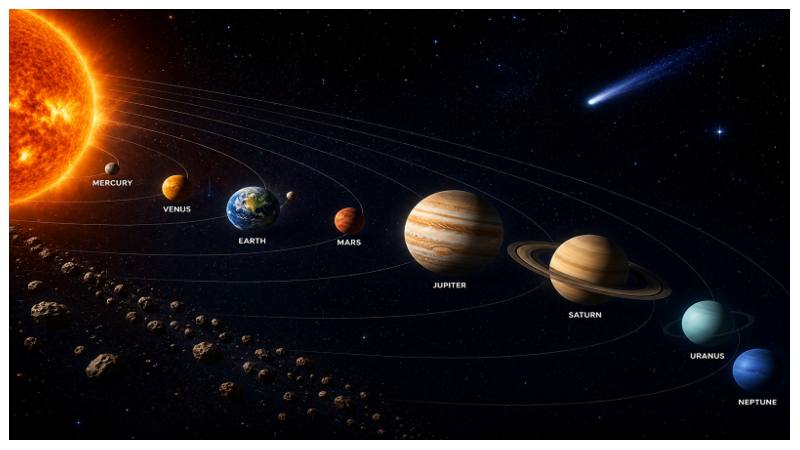
Our solar system contains extraordinary worlds.
- Mercury Has No Real Atmosphere: Without atmospheric protection, temperatures change drastically.
- Venus Is Hotter Than Mercury: Its thick carbon dioxide atmosphere traps heat.
- Earth Is Perfectly Positioned: Its location allows liquid water and life.
- Mars Has Evidence of Ancient Water: Riverbeds and mineral deposits suggest a wetter past.
- Jupiter Is Enormous: Its enormous size is large enough to hold more than 1,300 planets the size of Earth.
- Saturn’s Rings Are Made Mostly of Ice: They are composed of billions of particles.
- Uranus Spins Sideways: Its tilt causes extreme seasons.
- Neptune Has Violent Storms: Wind speeds can exceed 2,000 km/h.
The solar system remains full of discoveries waiting to be explored.
4. Hidden Secrets of Distant Planets
Exoplanets are distant worlds that revolve around stars beyond the boundaries of our solar system.
Thousands have already been discovered.
These distant worlds reveal incredible diversity.
- Lava Worlds: Their surfaces are molten rock.
- Ocean Worlds: Covered by vast global oceans.
- Super-Earths: Larger than Earth but smaller than Neptune.
- Rogue Planets: Drift through space without stars.
- Diamond Worlds: May contain compressed carbon structures.
Some exoplanets exist in habitable zones where liquid water may exist.
Scientists estimate billions of potentially habitable planets could exist in the Milky Way.
This raises exciting possibilities for extraterrestrial life.
5. Amazing Truths About Stars
Stars are the engines of the universe.
They create light, heat, and the elements needed for life.
- Stars Are Born in Nebulas: Massive gas clouds collapse under gravity.
- Color Reveals Temperature: Blue stars are hotter than red stars.
- The Sun Is Middle-Aged: It is about 4.6 billion years old.
- Massive Stars Burn Fast: They live shorter lives.
Small Stars Can Last Trillions of Years
Supernovae Create Heavy Elements
- Gold, silver, and iron form in stellar explosions.
- Every atom in our bodies was once inside stars.
- This means we are literally made of stardust.
6. How Black Holes Challenge Science
Black holes are among the strangest objects in space.
They form when massive stars collapse.
Their gravity becomes so intense that nothing escapes.
Important black hole features include:
- Event Horizon: The boundary of no return.
- Singularity: Theoretical point of infinite density.
- Time Distortion: Time slows dramatically nearby.
- Gravitational Lensing: Black holes bend light.
Black holes challenge science because they force physicists to combine relativity and quantum mechanics.
Scientists still do not fully understand what happens inside them.
7. The Mystery Behind Galaxies
Galaxies are massive cosmic systems.
They contain stars, planets, gas, dust, and dark matter.
Main types include:
| Galaxy Type | Description |
|---|---|
| Spiral | Rotating arms |
| Elliptical | Rounded structures |
| Irregular | Chaotic shapes |
The Milky Way contains over 100 billion stars.
At its center lies a supermassive black hole.
Galaxies often collide and merge.
The Milky Way will eventually merge with Andromeda.
These events shape cosmic evolution.
8. Mind-Blowing Cosmic Phenomena
Space contains extraordinary events.
- Supernovae: Massive stellar explosions.
- Pulsars: Rapidly spinning neutron stars.
- Magnetars: Stars with extreme magnetic fields.
- Quasars: Bright galactic cores.
- Gamma-Ray Bursts: The most energetic known explosions.
- Dark Matter: Invisible material influencing galaxies.
- Dark Energy: Accelerates universal expansion.
These phenomena reveal the universe’s dynamic nature.
9. The Most Surprising Discoveries in Space
Modern astronomy continues to make astonishing discoveries.
- Gravitational Waves: Confirmed Einstein’s predictions.
- Black Hole Imaging: Historic scientific breakthrough.
- Water on Mars: Evidence of ancient rivers.
- Exoplanet Atmospheres: Scientists detect chemical signatures.
- Interstellar Visitors: Objects from other systems.
These discoveries constantly reshape science.
10. How Space Exploration Changes Our Future
Space exploration provides practical benefits.
- Better Communication.
- Satellites connect the world.
- Improved Weather Forecasting.
- Medical Research.
- Climate Monitoring.
- GPS Navigation.
- Resource Discovery.
- Space technology improves everyday life.
Exploration also prepares humanity for future survival beyond Earth.
11. Unanswered Questions About the Universe
Many cosmic mysteries remain unsolved.
Scientists still ask:
- What caused the Big Bang?
- What is dark matter?
- What is dark energy?
- Are parallel universes real?
- Is alien life common?
These mysteries drive future research.
12. The Role of Technology in Space Discovery
Technology enables exploration.
Important tools include:
| Technology | Purpose |
|---|---|
| Space Telescopes | Observe ancient galaxies |
| Robotic Probes | Explore planets |
| AI Systems | Analyze data |
| Reusable Rockets | Reduce costs |
Without technology, modern astronomy would be impossible.
13. Why Learning Space Facts Matters
Learning about space offers many benefits.
It develops:
- Scientific Curiosity
- Critical Thinking
- Innovation
- Problem-Solving Skills
- Global Perspective
Understanding space helps humanity understand itself.
14. What the Future Holds for Cosmic Exploration
The future of exploration is extraordinary.
Upcoming possibilities include:
- Human Missions to Mars
- Permanent Moon Bases
- Searching Europa for Life
- Commercial Space Tourism
- Asteroid Mining
- Deep-Space Colonization
Humanity may one day become a multi-planetary species.
Final Thoughts on Space Facts
Space is the ultimate frontier.
This betterthiscosmos post betterthisworld: Space Facts reveals just a small portion of what the universe contains.
Every discovery raises new questions.
Every mission expands understanding.
The cosmos continues to inspire scientists, dreamers, and explorers across generations.
As technology advances, humanity will uncover even greater cosmic truths.
The universe is vast, mysterious, and full of possibilities.
Our journey to understand it has only just begun.